.png)
Amalgamation, Jackson's Newest Large Ensemble Work, an Extension to his Award-Winning Composition, Inundation
Amalgamation is a kaleidoscopic, complex, and colorful piece Jackson wrote as part of his Master's Thesis at the UMKC Conservatory. To start the work, Jackson takes the final chord from his award-winning piece, Inundation, an impactful 24-note microtonal cluster chord, and guides the material in an entirely new direction. Steeped in microtonality, extended techniques, and sonic gestures teeming with motion, he evokes an awe-struck and sensual soundscape for the listener through a diverse palette of innovative timbres.
See below for an in-depth motivic, harmonic, formal, and temporal analysis of the work, and how all of these "layers" amalgamate into one colossal movement of orchestral force and gesture.
A score-follower recording of the wind symphony version can be found here, but the orchestra version is readily available upon request.
For full scores/parts or inquiry regarding future performances, please contact Jackson directly.
Motivic
Structure
The original inspiration for this work began as a postlude to Inundation. The work begins with a massive, 24-note microtonal chord (all 12 chromatic pitches atop 12 more chromatic pitches detuned 50 cents, one quarter-step). It is within this Inundation Chord that the sound world of Amalgamation is explored.
The entire work is split into two large motivic areas: the Amalgamation Theme Area and the Inundation Theme Area. Before the start of each, the Inundation Chord dominates the texture.
C = Inundation Chord (or variation)
A = Amalgamation Theme
I = Inundation Theme
Amalgamation Theme Sample:
(headphones recommended)
Inundation Chord

Inundation Chord Sample:
(headphones recommended)
Amalgamation Theme
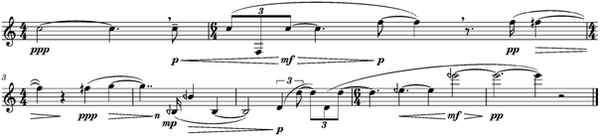
Inundation Theme
Inundation Theme Sample:


m. 1-50
m. 51-176
m. 177-195
m. 196-end
Key Motivic Events (follow-along for YouTube video and/or timeline):
Amalgamation Theme Area [0:00.0]
Chord [0:00.0]
C [0:00] m. 1-7, outlines 'Inundation' chord
C/A [0:21] m. 8 fragmented into different instrument groups and counterpoint added, First seeds of 'Amalgamation' theme is present within the rhythmic motive.
C [0:54] m. 20 restated
C [1:08] m. 23 with trills
C [1:25] m. 29 begins as sound mass, distills into unison c-sharp
A -> [2:35] m. 51 Saxophone solo adds the dimension of pitch to the theme
Development [2:35]
A -> [2:35] m. 51 Saxophone solo adds the dimension of pitch to the theme
[2:54] m. 54 passed to bassoon
[2:58] m. 55 passed to oboe
[3:06] m. 57 fragmentary echoes in saxophones and bassoons
[3:11] m. 58 horn
[3:14] m. 59 flute chorale
[3:25] m. 63 tenor sax
[3:33] m. 65 muted trumpet
[3:37] m. 68 polyphonic echoes in all winds before termination at m. 94
A [6:20] m. 122 fragments in saxophones
A [6:57] m. 129 substantially increases rate of development
A [7:34] m. 143 solo is passed off and significant development continues throughout entire 'B' section.
C [9:09] m. 177 return at height of 'B' section' Inundation' Theme Area [9:09]
Inundation Theme Area [9:09]
Chord [9:09]
C [9:09] m. 177 return at height of 'B' section
Development [10:11]
I [10:11] m. 196 begins fragmented and is echoed in the brass instruments first, slowly expanding overtime to cover the entire ensemble
A [11:21] m. 222 Theme returns entirely transformed into a full sweeping melody
A/I [11:44] m. 234 'Amalgamation' theme fuses with 'Inundation' theme
I [12:07] m. 243 in percussion and brass
I [12:25] m. 250
I [12:41] m. 258 in upper winds
A [12:49] m. 261, only appears slightly as it contributes intervallic/pitch material to the 'Inundation' theme
C [12:59] m. 266 tutti hit before falling back into sound mass
I [13:12] m. 270 entangled and repeated within the sound mass
I [14:05] m. 288 fragmentary, tutti
I [14:49] m. 297 bass clarinet
A/I [15:02] m. 301 flute melody heavily ornamented and vague at first, but eventually restates the 'Amalgamation' theme at m. 308-9 before
finally settling on the 'Inundation' theme at m. 310 (which is also echoed fragmentarily in the percussion).
Harmonic
Structure
There are three unique tonal areas within Amalgamation, though they are all so closely related to each other, it might be easier to think of the whole work as just one tonal area with microscopic shifts. Gradual modulation is used to subliminally increase tension throughout the work.
For almost seven minutes, different arrays of sound are produced, all gravitated in some way around the Fundamental Pitch C. From there, an ominous solo flute, distilled and detuned, pulls the ensemble into the key of C Quarter-Flat. After a cacophony of tonal and timbral destabilization, we are submerged fifty more cents into the Key of B. This ruminates for a few minutes while the form of the piece runs its course, slowly building. Further still, the brief tonicization of B-flat heightens the drama. The climactic return, a "breach" from the depths of lower-falling tonal areas, the Key of C returns, whereupon the final act of Amalgamation proceeds.
While Amalgamation primarily utilizes motivic, textural, and temporal manipulations to develop material, there are two examples of seemingly spontaneous bVI - I radiating throughout the ensemble. See analysis below.

m. 1-128
m. 129-165
m. 166-265
m. 266-end
Key Harmonic Events (follow-along for YouTube video and/or timeline):
Key of C [0:00.0] m. 1 - 128
bVI chord [5:47] (m. 114) There is a tonicization of A-flat major here, which foreshadows the most important progression of the work
beginning at m. 261
Key of C q-flat [6:48] m. 129 - 165
Key of B [9:16] m. 166 - 265
Tonicization of Bb [11:59] (m. 239) B-flat tonicization signaling the "lowest" tonal point in the work. From here, we build back up to B, then eventually pivot back to C
bVI chord [12:50] (m. 261 - 266) From B, there is a flat-submediant chord (G), which also acts as the pivot chord to C
Key of C [12:59] m. 266 - end
Formal
Structure
The complexity lying within the formal structure of Amalgamation is perhaps the primary vehicle for developing material and compelling the music to action throughout the piece.
Globally, it rests firmly in a Rounded Binary form: A, B, A', B' surrounded by an Intro and Coda.
The A Section presents itself as its own rotary form in five sections:
+ Monolithic Counterpoint
+ Sound Masses
+ Unison Signal
+ Brief Transitional Chorale
+ Rotation
Within the Rotation, there is a prominent 24-note tone row, which is a core foundational idea within the piece. It is derived from the Inundation Chord that opens the work.
24-Note Tone Row
Audio Sample:

As this tone row slowly revolves (six times total for both rotations), harmonic resonances ornament the row by suspending different neighboring pitches within the rows. The following chart maps out prominent harmonic resonances that can be produced using this system, derived from just-intonation. The fusion of serialist concepts with just-intonation create a sound world of harmonic richness while still maintaining a buoyant and uneasy lack of direction.

While the A Section of this piece is highly decorated and complex, the B Section is much more standard in its design, though chaotic in its demeanor. A whirring developing variation in of itself, it roars at the heights of this highly-decorated work.

m. 301-end
m. 129-181
m. 1-7
m. 182-300
m. 8-128
Key Motivic Events (follow-along for YouTube video and/or timeline):
Intro [0:00.0] m. 1-7
A Section [0:22] m. 8-128
Monolithic Counterpoint [0:22] m. 8-19
Sound Masses [0:54] m. 20-42
Unison Signal [2:07] m. 43-46
Brief Transitional Chorale [2:22] m. 47-50
Rotation 1 [2:35] m. 51-128 Includes Six Different Iterations of the Tone Row
r1 [2:35] m. 51 - m. 75 row 1 begins
r2 [3:53] m. 76 - m. 87 row 2 begins
r3 [4:17] m. 88 - m. 93 row 3 begins
i [4:28] m. 94 - m. 96 interruption
r4 [4:40] m. 97 - m. 102 row 4 begins
r5 [4:58] m. 103 - m. 113 row 5 begins
r6 [5:47] m. 114 - m. 129 row 6 begins
B Section [6:48] m. 129-181
Flute Solo [6:48] m. 129-143
Contra-Bassoon Solo [7:34] m.144-156
Build [8:10] m. 157-181
A' Section [9:22] m. 182-300
Monolithic Counterpoint [9:22] m. 182-195 Return of monolithic counterpoint
Rotation 2 [10:11] m.196-267
[11:21] "Amalgamation" theme is fully developed, based on the tone row
[11:33] Melody merges with motivic material from B section
[11:58] m. 239 - m. 241 Dramatic interruption of Rotation 2
[12:32] Begin the "spiraling out" process, akin to Rehearsal J in Rotation 1
Sound Masses [13:03] m. 268-283 Sound masses unexpectedly amalgamate
Unison Signal [13:52] m. 284-287
Inundation Chord [14:05] m. 288-300
B' Section & Coda [14:49] m. 301-end
Bass Clarinet Solo [14:49] m. 301-304 Bass clarinet entrance on "Inundation" theme, followed by flute echoing material from Cadenzetta.
Brief Transitional Chorale [15:13] m. 305-316 The "brief transitional chorale" from Rotation one comes back, this time with more
layers of overtones, now in the brass.
C Chord [15:55] m. 317-end Final chord in C major/minor/middle with a major seventh, flute on B.
Temporal
Structure
The tempo within Amalgamation is methodically structured. While the form of the work projects rounded binary, the tempo of this work is overlayed in a sort of rondo design. There are three temporal areas, all of which are defined using ratios.
For example, the first temporal area projects tempos that start at q=60, then going back and forth to q=80. These tempos are a 3:4 ratio relation to each other. The second temporal area projects tempos that start at q=60, switching to q=90: a 2:3 relation. While in the Rotation section of the piece (see Formal Structure above), the motion of the tone rows increases logarithmically. This logarithmic shift is continued during the second iteration of the first temporal area (m. 239-296), but now utilizing 2:3 tempo ratios instead of 3:4. This difference changes how we perceive not just the meter, but also time itself. The second iteration of the first temporal area develops at a faster rate than the former, while still maintaining a similar clarity of pace as the first iteration of the first temporal area.
The third temporal area is only set in one tempo: q=80. It functions as a sort of "temporal tonic," representing stability of pulse. This stability is used in the first iteration of the third temporal area (m. 144-195) to incite a rhythmic motor to propel the piece forward while the second iteration of the third temporal area (m. 296-end) is used to signal a resolve and coda to the work.

m. 296-end
m. 51-143
m. 196-238
m. 1-50
m. 144-195
m. 239-296
Temporal Area 2
Temporal Area 1
Temporal Area 1
Temporal Area 3
Temporal Area 2
Temporal Area 3
All Structures 'Amalgamated'
m. 1-50
m. 51-176
m. 177-195
m. 196-end
m. 51-176
m. 1-128
m. 129-165
m. 166-265
m. 266-end
m. 301-end
m. 129-181
m. 1-7
m. 182-300
m. 8-128
m. 296-end
m. 51-143
m. 196-238
m. 1-50
m. 144-195
m. 239-296
Temporal Area 2
Temporal Area 1
Temporal Area 1
Temporal Area 3
Temporal Area 2
Temporal Area 3
The graph above can be helpful to trace an internal narrative of all the amalgamated structures of the work. Take careful note of how many elements and sections of these analyses almost align with each other, but more often slightly mis-align. An effect is created where nothing is entirely settled, all parameters of the work are somehow in flux, and one transition will initiate a chain reaction for others to follow suit.
Amalgamation
is a composition that is built on a highly-saturated blend of process and spontaneity. Most of what has not been described in this analysis has been composed out of artistic intuition and spur-of-the-moment expression that "felt good." Amalgamation is a very physical work. The huge, whirring sound masses accompanied with the intimacy of stark solo textures implores the listener to move, to feel, and to lose themselves in a universe where structure breaks down, piles onto itself, and amalgamates out of what once was a focused and explicit Inundation of sound. I invite you to listen to this work, trust the underlying framework and processes, and let yourself be carried by the sounds around you.